
GST Career Opportunities After Certification: Your Complete Roadmap for 2026-2027
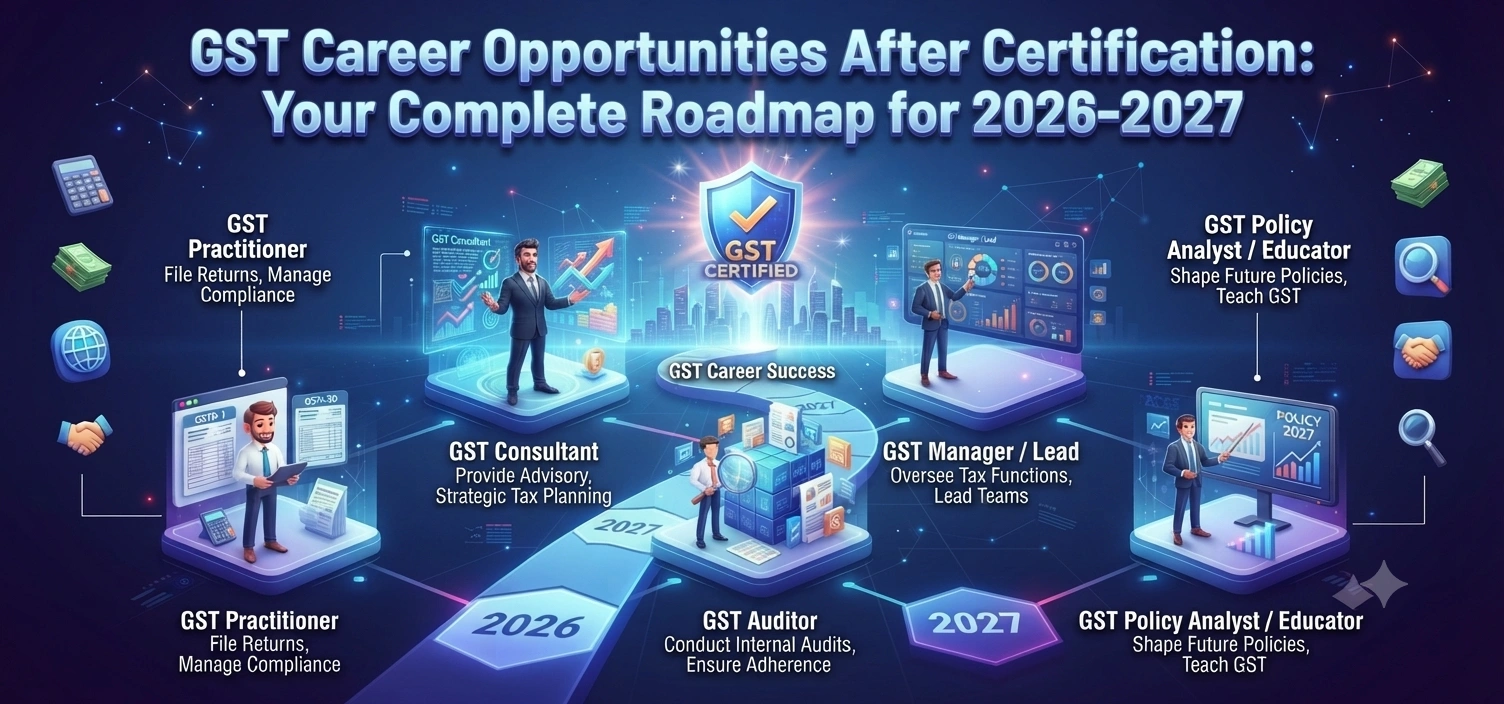
GST Career Opportunities After Certification: Your Complete Roadmap for 2026-2027
Got your GST certification? Congratulations! Youre standing at the threshold of one of India's most dynamic career landscapes. The GST ecosystem has exploded since 2017, and the demand for skilled professionals keeps climbing. But here's the real question: what comes next? Where do you go from that certificate to a thriving, well-paid career?
Let me be straight with you. GST certification alone won't guarantee success. But combined with the right strategy, it opens doors that most people don't even know exist. In this article, I'm sharing exactly what I've seen work in the market, the roles that are actually hiring, and how much you can realistically earn.
Why GST Certification Matters More Than Ever
Think about it. Every business in India—from the corner shop to multinational corporations—needs GST compliance. That's not a niche market. That's the entire economy. And they all need people who understand the rules, the returns, the audits, and the compliance nightmare that comes with indirect taxation.
Your GST certification proves you've got the technical knowledge. But employers want more. They want someone who can walk into their finance department and immediately reduce their GST liability, spot compliance risks, and handle audits without breaking a sweat.
GST professionals are in short supply relative to demand. This means better negotiating power for your salary, more job security, and the ability to pick roles that actually interest you.
Top Career Paths for GST Certified Professionals
1. GST Consultant (Independent or Firm-Based)
This is the most obvious path, and for good reason. GST consultants advise businesses on compliance, planning, and optimization. You can work for a Big 4 firm, a mid-size practice, or go solo.
Salary Range (2026-2027): Entry-level consultants earn ₹4-6 lakhs annually. Senior consultants with 5+ years experience? ₹15-25 lakhs. Partners in established firms? ₹30+ lakhs plus profit sharing.
What employers want: Strong communication skills, ability to explain complex rules in simple terms, and a track record of solving real client problems. Your certification is the entry ticket, but your ability to add value is what gets you paid.
2. In-House GST Manager
Large corporations, e-commerce companies, and manufacturing units all need dedicated GST managers. You'll handle returns, compliance, audit coordination, and GST planning for the entire organization.
Salary Range (2026-2027): ₹6-10 lakhs for junior roles, ₹12-18 lakhs for mid-level, ₹20-30 lakhs for senior positions. Plus benefits, bonuses, and stock options in some companies.
The advantage? Stability. You're not chasing clients. You're building systems, mentoring teams, and becoming indispensable to your organization.
3. GST Auditor
Audit firms desperately need GST specialists. You'll conduct GST audits, verify compliance, and prepare audit reports. It's detail-oriented work, but it pays well and keeps you sharp.
Salary Range (2026-2027): ₹5-8 lakhs starting out, ₹15-22 lakhs with experience. Senior audit managers earn ₹25-35 lakhs.
4. GST Content Creator & Trainer
Online learning platforms, YouTube channels, and corporate training programs all need GST experts. If you can explain complex concepts clearly, this path offers flexibility and passive income potential.
Earnings: Highly variable. Some trainers earn ₹2-5 lakhs annually from YouTube and courses. Others doing corporate training earn ₹10-20 lakhs.
5. GST Software Implementation Specialist
Companies like Tally, SAP, and specialized GST software providers need people who understand both the technical and compliance sides. You'll help businesses implement GST software solutions.
Salary Range (2026-2027): ₹6-12 lakhs for implementation specialists, ₹15-25 lakhs for senior roles.
Salary Comparison Table
| Role | Entry Level (0-2 yrs) | Mid Level (3-5 yrs) | Senior (5+ yrs) |
|---|---|---|---|
| GST Consultant | ₹4-6 L | ₹10-15 L | ₹20-30 L |
| In-House Manager | ₹6-10 L | ₹12-18 L | ₹20-30 L |
| GST Auditor | ₹5-8 L | ₹12-18 L | ₹25-35 L |
| Software Specialist | ₹6-12 L | ₹12-18 L | ₹20-28 L |
| Trainer/Content Creator | ₹2-5 L | ₹5-12 L | ₹15-25 L |
Note: These figures are based on market data for 2026-2027 and vary by location, company size, and individual performance.
What Employers Actually Look For
Your GST certification proves you know the rules. But here's what separates the ₹5 lakh professionals from the ₹20 lakh ones:
- Practical Experience: Can you actually implement GST strategies? Have you handled real audits? Worked with real businesses?
- Software Skills: Know Tally, SAP, or specialized GST software? That's a massive advantage. Many consultants don't.
- Industry Knowledge: Understanding e-commerce GST is different from manufacturing GST. Specialization pays.
- Communication: Can you explain GST to a non-finance person? Can you write clear reports? This skill is rarer than you'd think.
- Problem-Solving: Employers want people who reduce their GST burden, not just file returns on time.
- Compliance Mindset: Understanding not just the rules, but the intent behind them. This prevents costly mistakes.
Companies in 2026-2027 are actively looking for GST professionals who can also handle indirect tax planning, not just compliance. This is where the premium salaries are.
Building Your Career Strategy
Year 1: Foundation & Specialization
Get your GST certification if you haven't already. Then pick a specialization. Are you interested in e-commerce? Manufacturing? Services? Real estate? Each has unique GST challenges and commands premium rates.
Join a mid-size consulting firm or take an in-house role. You need real-world exposure. Classroom knowledge and practical knowledge are two different animals.
Year 2-3: Build Your Reputation
Start writing articles, contributing to industry forums, or speaking at webinars. Build your personal brand. In consulting, your reputation is your currency.
Develop expertise in GST software. Learn how to implement solutions, not just use them. This makes you invaluable.
Year 4+: Leverage Your Expertise
Now you can negotiate better salaries, move to senior roles, or start your own practice. You've got the experience and the reputation to back it up.
GST professionals who build strong reputations often get approached by clients directly. This leads to better rates, more flexibility, and the ability to choose your work.
Common Mistakes to Avoid
- Relying Only on Your Certificate: It's a starting point, not a destination. Keep learning. GST rules change constantly.
- Ignoring Soft Skills: Your technical knowledge means nothing if you can't communicate it. Invest in presentation and writing skills.
- Not Specializing: Generalists earn less. Pick a niche and become the expert in that niche.
- Staying in Your First Job Too Long: Your salary growth is fastest when you switch jobs. Don't be afraid to move after 2-3 years.
- Not Building a Network: In consulting, your network is your net worth. Attend conferences, join professional groups, stay in touch with colleagues.
Don't get comfortable in a low-paying role just because it's stable. The GST market is competitive. If you're not growing, you're falling behind.
Compliance Insights for Career Growth
Here's something most GST professionals miss: understanding compliance trends makes you more valuable. In 2026-2027, watch these areas:
- E-invoicing Expansion: More sectors are moving to mandatory e-invoicing. Professionals who understand this deeply are in demand.
- Data Analytics in GST: The government is using AI to detect non-compliance. Professionals who understand this can help clients stay ahead.
- International Trade GST: With India's growing exports, GST on international transactions is becoming complex. This is a premium specialization.
- Reverse Charge Mechanisms: These keep changing. Staying updated here makes you invaluable.
Subscribe to GST updates from the CBIC website, follow industry publications, and join professional groups. This keeps you ahead of the curve and makes you more valuable to employers.
Frequently Asked Questions
Final Thoughts
Your GST certification is valuable. Really valuable. But it's not a golden ticket. It's a foundation. What you build on that foundation—your experience, your reputation, your expertise—that's what determines your career trajectory.
The GST market in 2026-2027 is booming. Businesses are getting more sophisticated about tax planning. Compliance is getting more complex. This creates opportunity for professionals who are willing to go beyond the basics.
Start with a solid foundation. Pick a specialization. Build your reputation. Stay updated. Network relentlessly. Do this, and you won't just have a job—you'll have a thriving career with excellent earning potential.
GST professionals who continuously upskill and build strong client relationships often transition to senior leadership roles, business development, or start their own successful practices within 5-7 years.
Ready to Start Your Career With IICPA?
Learn practical Accounting, GST, Income Tax, Tally Prime, Excel, SAP, Power BI, QuickBooks, and job-oriented finance skills through live practical training by industry experts.
Trained & led by CA Poonam Gupta & Adv Lokesh Gupta
© 2026 IICPA Institute|Best Accounting & Finance Training Institute in India
9593330999|iicpaconnect@gmail.com|www.iicpa.in
This blog is published for educational and informational purposes only. For personalized career guidance, course counselling, or admission assistance, please contact IICPA Institute.