
How GST Affects Small Businesses in India: A Complete 2026-2027 Guide
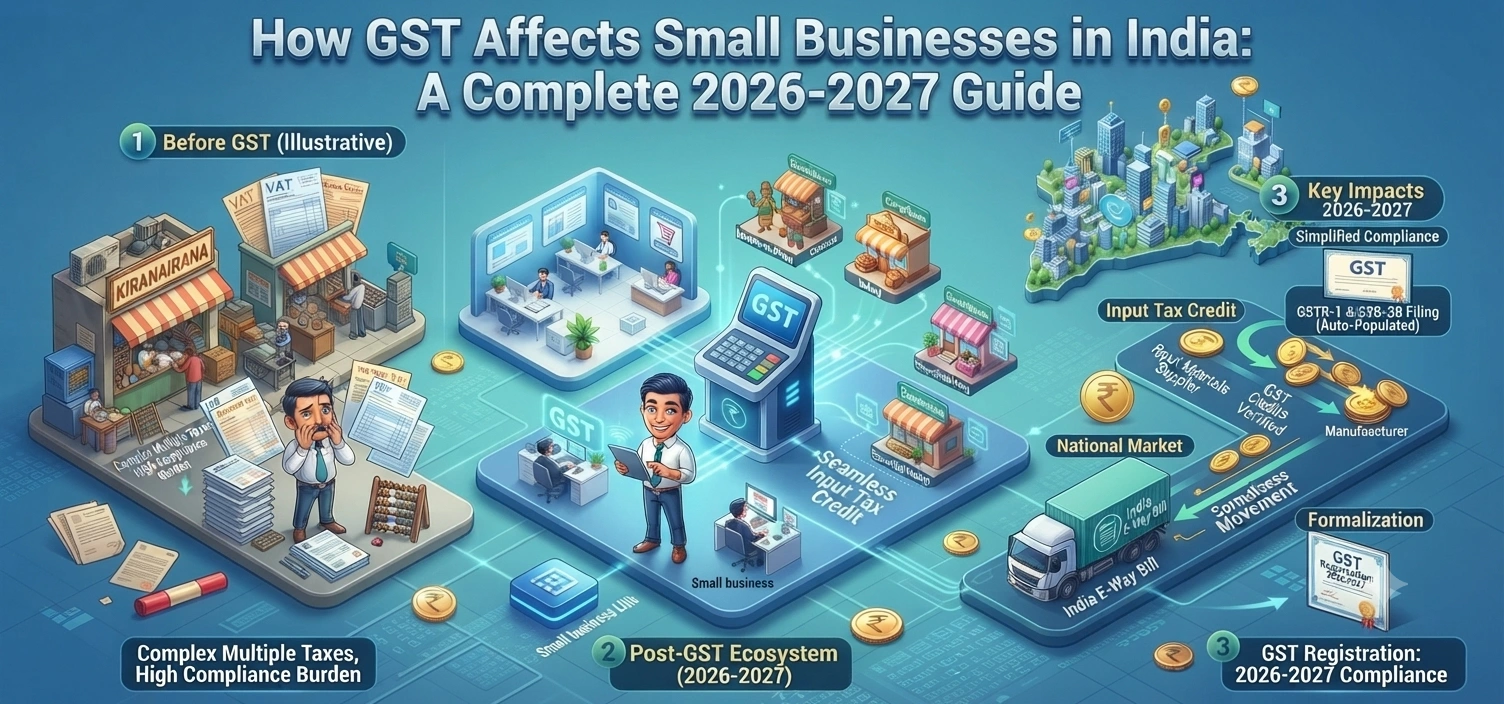
How GST Affects Small Businesses in India: A Complete 2026-2027 Guide
Running a small business in India? Then you know GST isnt just another tax. Its a game-changer that affects everything from your pricing strategy to your cash flow. But heres the thing—most small business owners dont fully understand how it works or how to leverage it properly. Lets break it down together.
What is GST and Why Should You Care?
Goods and Services Tax (GST) replaced multiple indirect taxes back in 2017. Instead of dealing with excise duty, VAT, service tax, and a dozen other levies, youve got one unified tax system. Sounds simpler, right? Well, it is—but only if you understand the rules.
For small businesses, GST means youre now part of a transparent, digital ecosystem. Every transaction gets recorded. Every invoice matters. Every rupee of input tax credit counts. This isnt about being punished—its about being part of a formal economy that rewards compliance.
As of 2026-2027, GST registration is compulsory for businesses with annual turnover exceeding Rs. 40 lakhs (Rs. 20 lakhs for services). Even below this threshold, voluntary registration offers significant advantages.
How GST Registration Impacts Your Business
Lets talk registration first. When you register for GST, youre getting a unique GSTIN (GST Identification Number). This number becomes your business identity in the GST network. But what does this mean practically?
- You can claim input tax credit on purchases
- Your customers see you as a legitimate, tax-compliant business
- You gain access to B2B transactions more easily
- Your business becomes eligible for loans and partnerships
- You must file monthly or quarterly returns
Heres a real example: Suppose youre running a small manufacturing unit. You buy raw materials for Rs. 1 lakh with 5% GST (Rs. 5,000). You sell finished goods for Rs. 1.5 lakhs with 12% GST (Rs. 18,000). Without GST registration, youre stuck paying that Rs. 5,000 as a cost. With registration? You claim it as input credit and only pay Rs. 13,000 to the government (Rs. 18,000 minus Rs. 5,000). That Rs. 5,000 stays in your pocket.
Input tax credit is your biggest advantage. Every GST you pay on business purchases can be deducted from GST you collect from customers. This dramatically reduces your actual tax liability.
GST Slabs and What They Mean for Your Pricing
GST comes in four main slabs: 0%, 5%, 12%, and 18%. Some items even attract 28% GST. Your product or service falls into one of these categories, and that determines your tax rate.
| GST Slab | Examples | Impact on Small Business |
|---|---|---|
| 0% | Unpackaged food, basic medicines | No tax collected, but input credit available |
| 5% | Packaged food, books, medicines | Lower tax burden, competitive pricing |
| 12% | Textiles, processed food, electronics | Moderate tax, balanced for most businesses |
| 18% | Services, luxury goods, software | Higher tax, requires careful cost management |
| 28% | Luxury items, sin goods | Very high tax, significant pricing impact |
Now, heres where many small business owners get confused. You cant just add GST on top of your price and expect customers to accept it. You need to build GST into your pricing strategy. If youre selling at 18% GST, your effective cost to the customer increases. This might affect demand, so you need to plan accordingly.
Compliance Requirements: What You Must Do
Lets be honest—GST compliance isnt optional. The government has a sophisticated tracking system, and non-compliance comes with serious penalties. But dont worry, its not as complicated as it sounds.
- File GSTR-1 (outward supplies) monthly or quarterly
- File GSTR-2A (inward supplies) to reconcile purchases
- File GSTR-3B (summary return) with tax liability
- Maintain proper invoices with GSTIN details
- Keep records for at least 6 years
- File annual return (GSTR-9) before March 31st
Missing GST filing deadlines attracts penalties of Rs. 100 per day (up to Rs. 5,000). Late payment of GST includes interest at 18% per annum. Repeated violations can lead to suspension of your GSTIN.
The good news? Most of this is now automated. GST portals are user-friendly, and many accounting software solutions integrate directly with GST systems. You dont need to be a tax expert—you just need to stay organized.
Cash Flow Impact: The Real Challenge
Heres something many small business owners overlook: GST affects your cash flow significantly. Why? Because you collect GST from customers but pay it to the government monthly or quarterly. If your customers delay payments, youre stuck paying GST from your own pocket.
Imagine this scenario: You sell goods worth Rs. 1 lakh at 18% GST to a customer on credit. You owe Rs. 18,000 in GST to the government next month. But your customer pays you after 60 days. Youve already paid the government, and youre waiting for customer payment. That Rs. 18,000 is tied up in working capital.
Poor cash flow management is the #1 reason small businesses struggle with GST. Always maintain a cash reserve equivalent to 1-2 months of GST liability. This prevents penalties and keeps your business running smoothly.
Special Schemes for Small Businesses
The government understands that small businesses need support. Thats why they introduced special schemes:
- Composition Scheme: If your annual turnover is below Rs. 2 crores, you can opt for composition. You pay a fixed percentage (1-5%) of turnover instead of regular GST. No input credit, but simpler compliance.
- Exemption Threshold: Businesses with turnover below Rs. 40 lakhs (Rs. 20 lakhs for services) dont need GST registration. But voluntary registration is still beneficial.
- E-commerce Operator Scheme: If you sell through platforms like Amazon or Flipkart, special rules apply.
Should you choose composition? Thats a strategic decision. If your business involves significant purchases (where input credit matters), regular GST is better. If youre a pure service provider with minimal purchases, composition saves you compliance headaches.
Common GST Mistakes Small Businesses Make
After years of working with small business owners, Ive seen the same mistakes repeatedly. Lets avoid them:
- Wrong Invoice Details: Missing GSTIN or incorrect HSN codes on invoices invalidates input credit claims.
- Mixing Personal and Business Expenses: Claiming personal GST as business input credit is a red flag for audits.
- Late Filing: Filing returns after deadlines attracts penalties even if you owe no tax.
- Ignoring E-way Bills: Moving goods without proper e-way bills can result in seizure and penalties.
- Not Reconciling GSTR-2A: Discrepancies between your purchases and GSTR-2A create compliance issues.
Practical Tips to Optimize Your GST
Now that you understand the challenges, lets talk solutions. Here are practical strategies to make GST work for you:
- Invest in GST Software: Tools like Tally, Zoho Books, or Busy automate calculations and filing. Cost? Rs. 5,000-15,000 annually. Benefit? Hours saved monthly.
- Maintain Digital Records: Keep all invoices, receipts, and bills digitally. The GST portal stores everything, making audits easier.
- Plan Your Purchases: Buy high-value items in months when you have GST liability. This maximizes input credit utilization.
- Regular Reconciliation: Match your records with GSTR-2A monthly. Catch discrepancies early.
- Hire a GST Consultant: For Rs. 2,000-5,000 monthly, a CA can handle your GST compliance. Worth every rupee.
Proper GST management isnt just about compliance—its about reducing your tax burden. Smart businesses use GST rules to optimize their tax liability legally. Input credit, composition schemes, and timing of purchases can save you 10-20% on taxes.
GST and Your Customers: Transparency Matters
Heres something often overlooked: GST affects your customer relationships. When you charge GST, youre transparent about it. Customers see the tax component separately on invoices. This builds trust.
B2B customers actually prefer GST-registered suppliers because they can claim input credit. Youre not just a vendor—youre a compliant business partner. This opens doors to larger contracts and better payment terms.
Frequently Asked Questions
Conclusion: Making GST Work for Your Business
GST isnt your enemy—its a tool. Yes, it requires compliance. Yes, it affects your cash flow. But it also levels the playing field, reduces corruption, and creates opportunities for legitimate businesses.
Small businesses that embrace GST properly gain competitive advantages. They access larger markets, attract better customers, and build credibility. Those that ignore it face penalties, audits, and operational disruptions.
Your action plan? First, understand your GST category and slab. Second, decide between regular and composition scheme. Third, invest in proper accounting software. Fourth, file returns on time, every time. Fifth, maintain meticulous records. Finally, consult a CA for strategic planning.
GST compliance isnt a burden—its an investment in your business's future. Start today, stay consistent, and watch your business grow with confidence.
Ready to Start Your Career With IICPA?
Learn practical Accounting, GST, Income Tax, Tally Prime, Excel, SAP, Power BI, QuickBooks, and job-oriented finance skills through live practical training by industry experts.
Trained & led by CA Poonam Gupta & Adv Lokesh Gupta
© 2026 IICPA Institute|Best Accounting & Finance Training Institute in India
9593330999|iicpaconnect@gmail.com|www.iicpa.in
This blog is published for educational and informational purposes only. For personalized career guidance, course counselling, or admission assistance, please contact IICPA Institute.