
GST Composition Scheme Explained Simply
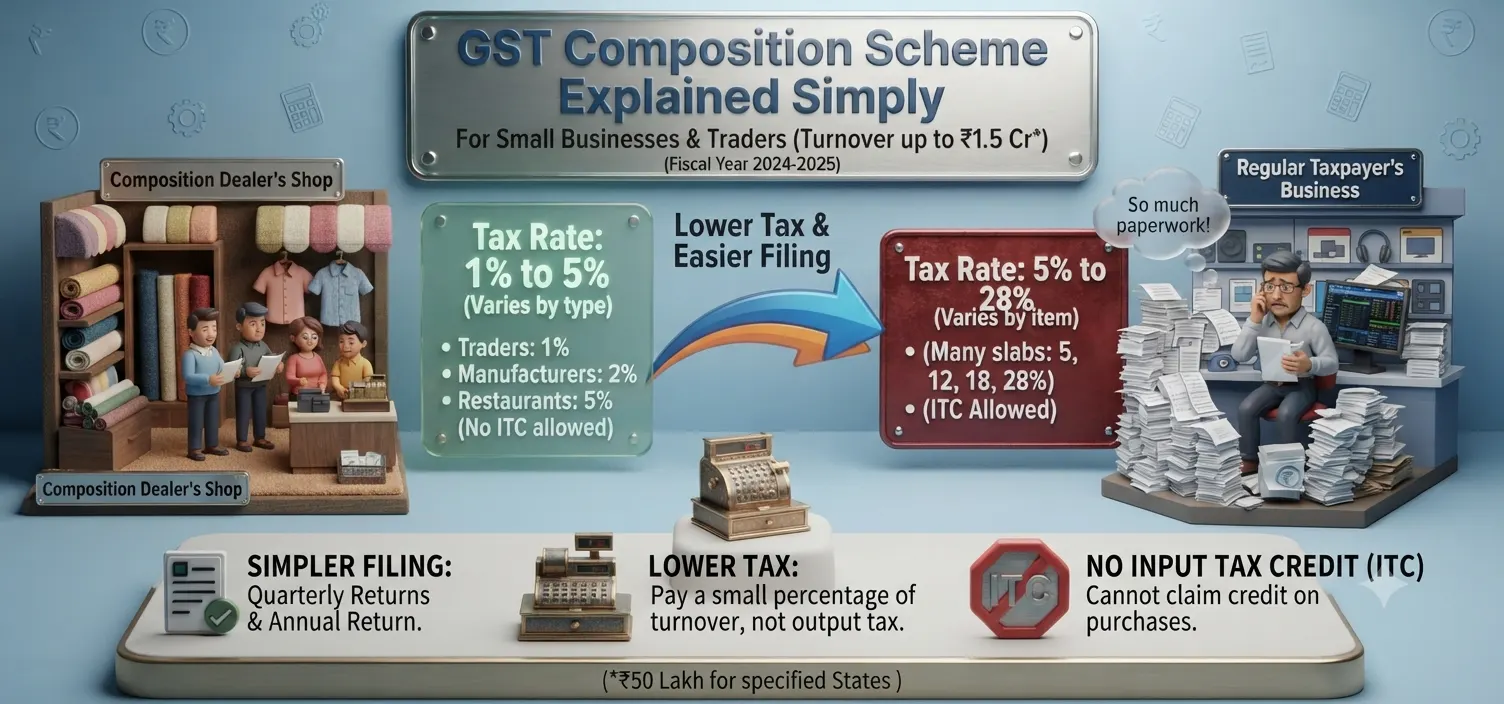
GST Composition Scheme Explained Simply
Youre running a small business and GST compliance feels overwhelming? The Composition Scheme might be your answer. This simplified tax regime lets eligible businesses pay a fixed percentage of turnover instead of calculating input-output taxes. Sounds simple, right? Lets break it down so you actually understand whats happening with your business taxes.
What Exactly Is the GST Composition Scheme?
The Composition Scheme is a simplified GST registration option designed for small businesses. Instead of tracking every input credit and output tax, youll pay a fixed percentage of your quarterly turnover. Think of it as a flat-rate tax system thats way easier to manage than the standard GST regime.
The Government introduced this scheme to reduce compliance burden for small traders, manufacturers, and service providers. Youre essentially trading the complexity of input-output calculations for a straightforward percentage-based payment system.
Composition Scheme reduces your compliance workload significantly. No need to maintain detailed records of input credits or file complex returns every month.
Who Can Opt for the Composition Scheme?
Not every business qualifies for this scheme. The Government has set specific eligibility criteria to keep it accessible for genuinely small businesses. Heres what you need to know about who can join.
- Your annual turnover must not exceed Rs. 50 lakhs (for most states in 2026-2027)
- You must be a manufacturer, trader, or service provider
- You cant be engaged in supply of goods or services that are exempt from GST
- You cant supply goods or services outside India (exports)
- You cant be a casual taxable person
- You cant supply goods through e-commerce platforms (with some exceptions)
Special states like Himachal Pradesh, Uttarakhand, and Jammu & Kashmir have higher turnover limits (Rs. 75 lakhs) for manufacturing businesses.
Composition Rates: What Youll Actually Pay
The tax rate depends on what your business does. The Government has set different percentages for manufacturers, traders, and service providers. Lets look at the current rates for 2026-2027.
| Business Type | Composition Rate | Payment Frequency |
|---|---|---|
| Manufacturers | 1% of turnover | Quarterly |
| Traders/Retailers | 1% of turnover | Quarterly |
| Service Providers | 3% of turnover | Quarterly |
| Restaurant Services | 5% of turnover | Quarterly |
See how straightforward this is? If youre a trader with Rs. 10 lakhs quarterly turnover, youll pay just Rs. 10,000 in GST. No input credit calculations, no complex adjustments. Just a simple percentage.
Real-World Example: How the Composition Scheme Works
Lets say youre Rajesh, a small electronics retailer in Delhi. Your quarterly turnover is Rs. 12 lakhs. Under the Composition Scheme, heres what happens:
- Quarterly turnover: Rs. 12 lakhs
- Composition rate: 1% (for traders)
- GST payable: Rs. 12,00,000 × 1% = Rs. 12,000
- You file one simple quarterly return
- No input credit claims, no complex reconciliation
Compare this to standard GST where Rajesh would need to track every purchase invoice, claim input credits, file monthly returns, and maintain detailed records. The Composition Scheme saves him hours of accounting work every quarter.
Composition Scheme is perfect for businesses where input credit isnt significant anyway. If youre buying goods at retail rates, youre not getting much input credit benefit in standard GST.
Key Advantages That Make Sense
Why would you choose this scheme? Theres actually several solid reasons.
- Simplified Compliance: File quarterly returns instead of monthly. Thats 9 fewer filings per year.
- Lower Compliance Cost: You dont need expensive accounting software or a full-time accountant. A basic spreadsheet works fine.
- Predictable Tax Outgo: You know exactly what youll pay each quarter. No surprises, no adjustments.
- Reduced Documentation: You dont need to maintain detailed input credit records. This saves storage space and time.
- Faster Accounting: Your month-end accounting closes in hours, not days.
- Lower Audit Risk: Simpler returns mean fewer compliance issues and lower audit probability.
Important Limitations You Must Know
Before you jump into the Composition Scheme, understand what youre giving up. This scheme isnt perfect for every business.
You cannot claim input tax credit under Composition Scheme. If youre buying goods at wholesale rates with significant GST, this scheme might cost you more money.
- No input credit means youre paying GST on your purchases without recovery
- You cant issue tax invoices to B2B customers (only bill of supply)
- Your customers cant claim input credit from your invoices
- You cant supply goods through e-commerce platforms (mostly)
- If turnover exceeds Rs. 50 lakhs, you must switch to standard GST
- You cant claim ITC on capital goods or inputs
If your business supplies goods to other GST-registered businesses, they wont be happy with bill of supply invoices. They need tax invoices to claim input credit. This could hurt your B2B sales.
Composition Scheme vs. Standard GST: Which Is Better?
Heres the real question: should you choose Composition or standard GST? Lets compare them side by side.
| Factor | Composition Scheme | Standard GST |
|---|---|---|
| Tax Rate | 1-5% fixed | 5-28% (varies by product) |
| Input Credit | Not allowed | Fully allowed |
| Filing Frequency | Quarterly | Monthly |
| Invoice Type | Bill of supply | Tax invoice |
| B2B Friendly | No | Yes |
| Compliance Burden | Low | High |
Choose Composition if youre B2C focused, have low input credit potential, and want simplicity. Choose standard GST if youre B2B focused, have significant input costs, or supply goods through e-commerce.
How to Register Under Composition Scheme
The registration process is straightforward. You can opt for Composition Scheme when you first register for GST or switch from standard GST later.
- Log into the GST portal (gst.gov.in)
- Fill Form GST REG-1 (for new registration) or Form GST REG-2 (for switching)
- Select "Composition Scheme" as your registration type
- Upload required documents (PAN, Aadhaar, address proof, etc.)
- Submit and wait for approval (usually 3-7 days)
- Download your GST certificate
You can switch from standard GST to Composition Scheme anytime, but you must wait 2 years before switching back to standard GST.
Compliance Requirements Under Composition Scheme
Even though Composition Scheme is simpler, you still have compliance obligations. Dont think you can ignore them.
- File quarterly returns (GSTR-4) by the 18th of the month following the quarter
- Pay GST by the 18th of the month following the quarter
- Maintain books of accounts and records for 6 years
- Issue bill of supply (not tax invoice) to customers
- Keep purchase invoices for audit trail
- File annual return (GSTR-9A) if required
- Update turnover if it exceeds Rs. 50 lakhs
Frequently Asked Questions
When Composition Scheme Makes Perfect Sense
Lets be honest: Composition Scheme isnt for everyone. But for certain businesses, its absolutely the right choice.
Youre a perfect fit if: Youre a retail trader selling directly to consumers, your annual turnover is under Rs. 40 lakhs, you buy goods at retail rates (minimal input credit), you dont supply through e-commerce, and you want to keep accounting simple.
Youre a poor fit if: Youre selling to other GST-registered businesses, you have significant input costs with high GST, youre planning rapid growth beyond Rs. 50 lakhs, you supply through e-commerce platforms, or you need to claim input credit on capital investments.
For a small retail shop owner, Composition Scheme can save Rs. 15,000-20,000 annually in accounting and compliance costs. Thats real money for a small business.
Common Mistakes to Avoid
Ive seen businesses make these mistakes repeatedly. Learn from them.
- Mistake 1: Issuing tax invoices instead of bill of supply. This is illegal and can result in penalties.
- Mistake 2: Not tracking turnover and exceeding Rs. 50 lakhs limit. You must switch immediately when you cross this threshold.
- Mistake 3: Claiming input credit. You cant do this under Composition Scheme. Period.
- Mistake 4: Missing quarterly return deadlines. Even though filings are quarterly, deadlines are strict.
- Mistake 5: Not maintaining proper records. You still need to keep books of accounts for 6 years.
Final Thoughts: Is Composition Scheme Right for You?
The Composition Scheme is a genuine relief for small businesses drowning in GST compliance. Its simpler, cheaper to manage, and predictable. But its not a one-size-fits-all solution.
Before you decide, honestly assess your business. Are you B2C or B2B? Do you have significant input costs? Are you planning to grow beyond Rs. 50 lakhs? Will your customers need tax invoices? Answer these questions truthfully, and the right choice becomes obvious.
Remember, you can always switch later (after 2 years), but the decision youre making today will impact your compliance burden for the next 24 months. Take time, consult your CA, and make an informed choice. Your future self will thank you.
Ready to Start Your Career With IICPA?
Learn practical Accounting, GST, Income Tax, Tally Prime, Excel, SAP, Power BI, QuickBooks, and job-oriented finance skills through live practical training by industry experts.
Trained & led by CA Poonam Gupta & Adv Lokesh Gupta
© 2026 IICPA Institute|Best Accounting & Finance Training Institute in India
9593330999|iicpaconnect@gmail.com|www.iicpa.in
This blog is published for educational and informational purposes only. For personalized career guidance, course counselling, or admission assistance, please contact IICPA Institute.